An observational study observes individuals and measures variables of interest but does not attempt to influence the responses.
An experiment deliberately imposes some treatment on individuals to measure their responses on people, animals, or objects (experimental units). In order to find a causative relationship, you must use an experiment instead of an observation study.
Confounding occurs when two variables are associated in such a way that their effects on a response variable cannot be distinguished from each other. For example, the relationship between obesity and heart disease might be affected by other variables like age, gender, or race.
If you are asked to identify a possible confounding variable in a given setting, you are expected to explain how the variable you chose:
- Is associated with the explanatory variable
- Affects the response variable
A specific condition applied to the individuals in an experiment is called a treatment. If an experiment has several explanatory variables, a treatment is a combination of specific values of these variables.
The experimental units are the smallest collection of individuals to which treatments are applied. When the units are human beings, they often are called subjects.
Most experiments use a design as follows: Experimental units -> Treatment -> Measure response
How to experiment well
Often, the remedy for confounding is to do a comparative experiment. Most well-designed experiments compare two or more treatments. Comparison, however, isn't enough by itself to produce trustworthy results. If the treatments are given to groups that differ greatly when the experiment begins, bias will result. The solution to the problem of bias in sampling is random selection. In experiments, the solution is random assignment, which means that experimental units are assigned to treatments using a chance process.
Random selection is when the experimenter randomly selects experimental units to be a part of the experiment. Random selection is needed to make inferences about population. Random assignment is when the experimenter randomly assigns experimental units to be a part of a specific treatment group. Random assignment is needed to make cause and effect inferences.
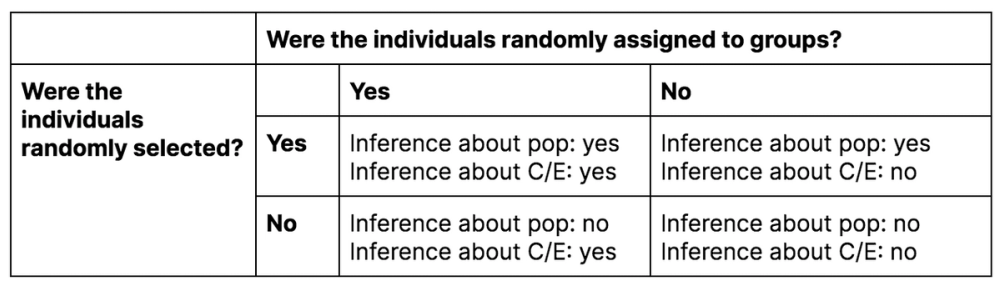
A well-designed experiment tells us that changes in the explanatory variable causes changes in the response variables. To be more exact, it tells us that this happened for these people in this environment of this specific experiment. Lack of realism may limit our ability to apply the conclusions of an experiment to the settings of greatest interest.
Be sure to get as much credit as possible on the exam when describing how you assign treatments to experimental units in an experiment:
- Method used must be random
- Method used must be described in sufficient detail
- Address how you will deal with repeated numbers that come up when using a random number generator or random number table
A placebo is a dummy pill that looks and tastes like the medicine being tested, but has no active ingredient.
The Placebo Effect is the response to a dummy treatment. The psychological effect of taking a pill, even a dummy pill, could have beneficial physiological symptoms that cannot be attributed to the medicine itself.